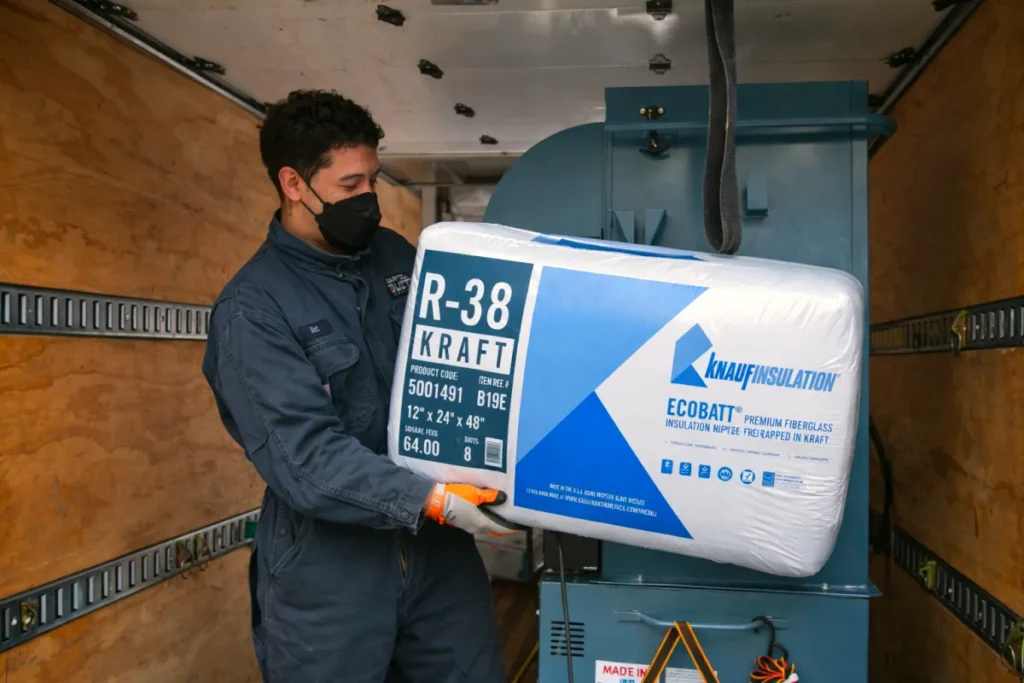
If your energy bills seem a little higher than they should be—or certain rooms in your home just never feel quite right, no matter what you do with the thermostat—the answer might be right above your head. Understanding what R-value means for attic insulation is one of the most important and most overlooked steps in keeping a home comfortable and energy-efficient year-round.
You’ve probably seen the term on insulation packaging or heard it mentioned by a contractor. But what does it actually mean? Why does it matter so much for your attic specifically? And how do you know if the insulation in your home is doing its job?
This guide breaks it all down in plain language, so you can make confident, informed decisions about your home’s insulation—and your comfort.
What Is R-Value in Insulation?
The “R” in R-value stands for resistance—specifically, thermal resistance. R-value is the standardized measure of an insulation material’s ability to slow down the flow of heat. The higher the R-value, the better the material is at resisting heat transfer through it.
Think of it like a winter coat. A thin fleece jacket lets the cold in pretty quickly, while a heavy-duty insulated parka keeps you warm for hours. Insulation with a higher R-value acts like that heavy parka for your home—it creates a stronger barrier between the conditioned air inside and the outdoor temperatures trying to force their way in.
It’s worth noting what R-value isn’t: it’s not a measure of air sealing, soundproofing, or moisture resistance. It is specifically and only a measure of thermal resistance—how well a material slows the conductive movement of heat.
How R-Value Is Calculated
R-value is determined under controlled laboratory conditions. During testing, a material is placed between two plates maintained at different temperatures. Scientists measure how much heat passes through the material over time, then assign a standardized numerical rating. This process ensures that R-values are consistent and comparable across all insulation products on the market.
Three key factors influence a material’s R-value:
- Thickness: More material generally means more resistance to heat flow.
- Material composition: Different substances conduct heat at different rates. Fiberglass, cellulose, and spray foam all behave differently at the same thickness.
- Density: Denser materials may restrict air movement more effectively, while overly compressed insulation can actually lose R-value.
R-Value vs. U-Value: What’s the Difference?
You may also encounter the term U–value when researching home energy efficiency. U-value and R-value are inverses of each other. While R-value measures resistance to heat flow, U-value measures the rate of heat transfer—the lower the U-value, the better the performance. U-value is most commonly used for windows, doors, and skylights. For insulation products, R-value is the standard, and it’s what you’ll see on product labels and building code requirements.
Why the Attic Is the Most Important Place to Get R-Value Right
Your attic is ground zero for heat loss in winter and heat gain in summer. Here’s why:
Heat rises. Warm air naturally rises, so during cold months, the heated air you’re paying for is constantly trying to escape through your ceiling and into the attic. During hot months, the sun bakes the roof, and that heat radiates downward into your living space unless there’s adequate insulation to block it.
Attics are also typically constructed with lighter materials—wood framing, roof decking, and roofing materials—none of which offer meaningful natural thermal resistance on their own. Without proper insulation installed in the attic floor or roof deck, your heating and cooling system is essentially fighting a losing battle.
The Three Mechanisms of Heat Transfer in an Uninsulated Attic
Understanding how heat moves helps explain why R-value matters so much. There are three primary mechanisms:
- Conduction: Heat travels directly through solid materials. In an uninsulated attic, heat conducts through the ceiling drywall and wood framing with minimal resistance.
- Convection: Heat moves through the air. Warm air rises to the ceiling; cool air sinks. Without adequate insulation, this cycle accelerates heat loss or gain.
- Radiation: Heat radiates from warm surfaces to cooler ones. On a hot summer day, a sun-heated roof deck radiates heat downward into the attic space and, eventually, into your living areas.
Effective attic insulation addresses all three of these pathways, making it far more impactful than insulating walls or floors alone.
How Does R-Value Affect Energy Efficiency?
The relationship between R-value and energy efficiency is direct and significant. When attic insulation doesn’t meet the recommended R-value for your climate, your heating and cooling system compensates by running longer and more frequently. That means higher energy consumption and higher energy bills—often without homeowners realizing insulation is the culprit.
According to the U.S. Department of Energy, homeowners can save an average of 15% on heating and cooling costs (or up to 11% of total energy costs) by air sealing and insulating key areas of the home, including the attic. For many households, that adds up to hundreds of dollars per year.
Beyond the financial savings, proper R-value insulation also improves comfort. Rooms feel more evenly tempered, drafts are reduced, and that frustrating hot-in-summer, cold-in-winter inconsistency largely disappears.
The Hidden Costs of Under-Insulated Attics
The costs of inadequate attic insulation go beyond monthly energy bills. When insulation fails to maintain stable surface temperatures, it opens the door to moisture and condensation problems. Here’s how that plays out:
- Condensation and moisture buildup: When warm interior air meets cooler attic surfaces, moisture condenses. Over time, this creates conditions favorable for mold and mildew growth.
- Structural damage: Persistent moisture leads to wood rot in framing and roof decking—repairs that are far more expensive than a simple insulation upgrade.
- Pest attraction: Damp, deteriorating insulation is an inviting nesting ground for rodents and insects.
- Air quality issues: Mold spores and allergens from a compromised attic can circulate through your home’s HVAC system, affecting the air your family breathes.
Taking R-value seriously isn’t just about comfort or savings. It’s about protecting the long-term integrity of your home.
What R-Value Should Attic Insulation Be? A Guide by Climate Zone
One of the most common questions homeowners ask is: What R-value is right for my attic? The answer depends on where you live. The U.S. Department of Energy and ENERGY STAR divide the country into eight climate zones, each with specific R-value recommendations based on heating and cooling demands. Most local building codes adopt the International Energy Conservation Code (IECC), which aligns with these same DOE recommendations by zone.
ENERGY STAR Recommended Attic R-Values by Climate Zone
| Climate Zone | Region (Examples) | Uninsulated Attic | Already Has 3–4 Inches |
| Zone 1 | Hawaii, southern Florida | R-30 | R-25 |
| Zone 2 | Gulf Coast, southern Texas | R-49 | R-38 |
| Zone 3 | Southeast, central California | R-49 | R-38 |
| Zone 4A & 4B | Mid-Atlantic, Pacific Northwest | R-60 | R-49 |
| Zones 5, 4C | Great Lakes, New England | R-60 | R-49 |
| Zones 6–8 | Northern states, Alaska | R-60 | R-49 |
Source:ENERGY STAR Recommended Home Insulation R-Values
You can find your specific climate zone using the DOE’s Zone Lookup Map. A practical note: if your attic already has some insulation, you don’t necessarily need to start from scratch. What matters is achieving the target total R-value, not how many layers or materials are used to get there.
What R-Value Insulation Is Best for Hot Climates?
Homeowners in warmer climate zones—like much of the American South and Southwest—sometimes wonder whether high R-values are really necessary since winters are mild. The answer is yes. In hot climates, the primary challenge is heat gain from above, not heat loss through the floor. High-R-value attic insulation acts as a shield against the intense radiant heat from a sun-baked roof, keeping living spaces significantly cooler and reducing air-conditioning loads during long, hot summers.
For Southern California specifically, Climate Zone 3 recommendations call for R-49 in uninsulated attics and R-38 when upgrading existing insulation. Given the region’s warm, dry summers and mild but real winters, meeting these benchmarks is one of the most cost-effective home energy upgrades available.
Types of Insulation and Their R-Values Per Inch
Different insulation materials achieve different R-values per inch of thickness, which directly affects how much material your attic needs to meet the recommended target. The quick-reference table below summarizes the most common options, followed by a closer look at each.
R-Value Comparison by Insulation Material
| Insulation Type | R-Value Per Inch | Approx. Installed Cost (Per Sq Ft) | Best Use Case |
| Fiberglass Batts | R-2.2 – R-3.8 | $0.30 – $1.50 | New attics, accessible spaces |
| Loose-Fill Fiberglass | R-2.2 – R-3.8 | $1.00 – $3.00 | Topping off existing attic insulation |
| Blown-In Cellulose | R-3.2 – R-3.8 | $1.00 – $4.00 | Retrofitting existing attics, irregular spaces |
| Spray Foam (Open-Cell) | R-3.5 – R-3.7 | $2.00 – $5.00 | Air sealing + insulating simultaneously |
| Spray Foam (Closed-Cell) | R-6.0 – R-7.0 | $2.00 – $5.00 | Tight spaces, moisture-prone areas |
| Rigid Foam Board | R-3.8 – R-6.5+ | $0.25 – $1.50 (material only) | Attic hatches, roof decks, cathedral ceilings |
| Mineral Wool (Rockwool) | R-3.7 – R-4.2 | $0.80 – $1.50 | Fire-resistant applications, hot/humid climates |
*Cost ranges reflect typical U.S. installed pricing and vary by region, project size, and contractor.
Fiberglass Batts and Loose-Fill Fiberglass
Fiberglass is the most widely used insulation material in residential attics. Batts (pre-cut rolls) typically offer R-2.2 to R-3.8 per inch, while loose-fill fiberglass blown into an attic achieves similar per-inch values. Loose-fill is especially effective in existing attics because it fills irregular spaces, gaps around joists, and hard-to-reach areas that batts can’t easily cover. To achieve R-49 with loose-fill fiberglass, you’d typically need approximately 13 to 16 inches of installed depth.
Blown-In Cellulose
Made primarily from recycled paper products, blown-in cellulose provides roughly R-3.2 to R-3.8 per inch. It’s an environmentally friendly option that performs well in existing attics—particularly for topping off existing insulation to reach the recommended R-value. It also offers natural pest-deterrent properties due to the borate compounds used in its manufacturing. Reaching R-49 with cellulose requires approximately 13 to 15 inches of depth.
Spray Foam Insulation
Spray foam comes in two varieties:
- Open-cell spray foam: R-3.5 to R-3.7 per inch — softer, more flexible, and more affordable
- Closed-cell spray foam: R-6.0 to R-7.0 per inch — denser, more rigid, and provides an air and moisture barrier simultaneously
Spray foam is particularly valuable in attics because it insulates and air seals in a single application. It’s commonly used around penetrations, on the underside of roof decks, and in hard-to-insulate spaces where batts or blown-in materials can’t reach. Closed-cell spray foam’s high per-inch performance means you can achieve R-49 with only 7 to 8 inches of material—a significant advantage in space-constrained applications.
Rigid Foam Boards
Rigid foam boards come in three main types—EPS (expanded polystyrene), XPS (extruded polystyrene), and polyisocyanurate—with R-values ranging from R-3.8 to R-6.5+ per inch. Foam boards are commonly used on attic hatches, as roof-deck insulation in cathedral-ceiling applications, and as insulative wall sheathing in new construction. They’re especially useful in tight spaces where high performance is needed in limited depth.
Mineral Wool (Rockwool)
Mineral wool—also marketed as Rockwool or stone wool—offers R-3.7 to R-4.2 per inch and brings a unique set of advantages beyond thermal performance. It is naturally fire-resistant (non-combustible up to very high temperatures), provides meaningful soundproofing, and holds up well in humid environments without losing its structure. It’s an especially good choice for homeowners in hot, humid climates where moisture resistance is a priority alongside thermal performance. Mineral wool costs slightly more upfront than fiberglass, but its durability and multi-benefit performance often make it a strong long-term value.
Radiant Barriers: A Supplemental Tool for Hot Climates
In warm, sunny climates like Southern California, standard insulation is often paired with a radiant barrier—a reflective foil material typically installed on the underside of roof rafters or over the attic floor. Unlike conventional insulation, a radiant barrier doesn’t slow conductive heat transfer and doesn’t carry a traditional R-value. Instead, it reflects radiant heat away from the attic before it can be absorbed.
According to the U.S. Department of Energy, radiant barriers can reduce cooling costs by 5% to 10% in warm, sunny climates—and can reduce attic temperatures by up to 30°F on hot days. They’re most effective when cooling ducts run through the attic and are less cost-effective in cold climates, where adding more conventional insulation is typically the better investment.
Radiant barriers are not a replacement for insulation—they’re a complement to it. For homeowners in Zone 3 climates looking to maximize cooling efficiency, pairing a radiant barrier with properly rated attic insulation is among the most effective approaches.
Why Labeled R-Value Isn’t Always What You Get: Installation Matters
Here’s something important that insulation packaging doesn’t always make clear: the R-value printed on the label is measured under ideal laboratory conditions. Real-world installed performance can be meaningfully lower if installation isn’t done correctly.
Common installation problems that reduce effective R-value include:
- Compression: Squeezing fiberglass batts into a space smaller than their rated thickness reduces their R-value proportionally.
- Gaps and voids: Even small gaps in insulation coverage create pathways for heat to move freely, dramatically reducing overall thermal performance.
- Thermal bridging: Heat conducts through wood framing studs and joists, bypassing insulation entirely. This is an inherent limitation that proper insulation design accounts for.
- Settling over time: Blown-in insulation can settle and compact, reducing depth and therefore R-value.
The Critical Role of Air Sealing
This is one of the most important points about attic insulation that is often underemphasized: insulation slows conductive heat transfer, but air leaks bypass the insulation entirely.
Even a well-insulated attic can significantly underperform if air flows freely through ceiling penetrations. Common air leak locations include:
- Recessed light fixtures
- Plumbing and electrical penetrations
- Attic hatches and pull-down stairs
- Gaps around chimneys and flue pipes
- Spaces behind knee walls
The right approach is to air seal these penetrations before adding or upgrading insulation. Air sealing and insulating together produce dramatically better results than either strategy alone—and it’s the approach recommended by both ENERGY STAR and the DOE.
Signs Your Attic Insulation May No Longer Be Doing Its Job
Insulation doesn’t last forever. Over time, R-values decline due to a number of factors:
- Moisture intrusion: Wet insulation compresses and loses the air pockets that are essential for thermal resistance.
- Settling: Loose-fill materials compact over time, reducing depth and coverage.
- Pest damage: Rodents nest in and tunnel through insulation, destroying its structure.
- Foot traffic: Attic access for storage or repairs compresses insulation and creates gaps.
How to Check Your Current Insulation Level
You don’t need a contractor to get a ballpark sense of whether your attic insulation is adequate. Here’s a simple DIY check:
- Access your attic safely using proper footing (step on framing members, not the drywall between them).
- Look for your ceiling joists. If you can clearly see the tops of the joists, your insulation is almost certainly below recommended levels for most climate zones.
- Check for paper facing. If existing insulation has a paper or foil facing, the R-value is often printed directly on it—no math required.
- Use a ruler or tape measure to check the depth of your current insulation.
- Estimate your R-value. If there’s no label, multiply the depth in inches by approximately 3 as a rough estimate for fiberglass or cellulose. For example, 5 inches of loose-fill fiberglass ≈ R-15.
- Compare to the ENERGY STAR recommendations for your climate zone using the table above.
If your current insulation falls short, it’s a strong signal that an upgrade could meaningfully reduce your energy bills and improve year-round comfort.
Professional Installation vs. DIY: What You Should Know
Some attic insulation projects are reasonable DIY undertakings—for example, adding fiberglass batts over existing insulation in a straightforward, accessible attic. But many situations call for professional installation:
- Spray foam application requires specialized equipment and training; improper application can create voids and off-gas harmful chemicals during curing.
- Homes with existing moisture damage, pest activity, or asbestos-era insulation should be professionally assessed before any new insulation is added.
- Air sealing around complex penetrations (chimneys, flue pipes, electrical boxes) is best handled by professionals familiar with fire codes and building science.
- Achieving the full target R-value in irregularly shaped attics with multiple penetrations requires experience to execute correctly.
A professional insulation assessment will evaluate your current insulation levels, identify air leaks, check for moisture issues, and recommend the most cost-effective path to meeting your target R-value. Given how significantly proper insulation affects both comfort and energy costs, professional installation is often the smarter long-term investment.
Key Takeaways: What R-Value Means for Your Home
R-value is the single most important number to understand when evaluating your attic insulation. It tells you exactly how well your insulation resists heat flow—and whether it’s actually protecting your home the way it should.
To summarize what we’ve covered:
- R-value measures thermal resistance. Higher is better, up to the recommended level for your climate zone.
- The attic is the highest-priority area for proper R-value insulation because heat rises and attic construction offers minimal natural thermal resistance.
- Climate zone matters. ENERGY STAR recommendations range from R-30 in warm climates to R-60 in cold ones, and most local building codes follow the same IECC-aligned targets.
- Material type affects performance per inch. Spray foam, rigid foam boards, mineral wool, fiberglass, and cellulose all achieve different R-values at the same thickness—and carry different cost profiles.
- In hot climates, radiant barriers complement insulation by reflecting radiant heat before it enters the attic, and can trim cooling costs by up to 10%.
- Installation quality is as important as R-value. Gaps, compression, and air leaks can dramatically reduce real-world performance regardless of what the label says.
- Insulation degrades over time due to moisture, settling, and pests—making periodic inspection a smart habit.
If you’re not sure whether your attic insulation is pulling its weight, the most productive next step is a professional assessment. A knowledgeable technician can measure your current R-value, identify air leaks, check for moisture concerns, and give you a clear picture of what’s actually happening up there.
Breathe Easier with Capitol Duct Cleaning
At Capitol Duct Cleaning, we understand that a comfortable, healthy home starts with what you can’t always see—the air you breathe and the systems that condition it. As a NADCA-certified, veteran-owned and operated local business, we bring the same values to every job that we carried in uniform: integrity, thoroughness, and genuine care for the people we serve.
Our team is knowledgeable, punctual, and committed to your satisfaction—because we believe you deserve a professional who treats your home the way they’d want their own treated. Whether you have questions about your attic’s insulation, your air duct system’s performance, or how to improve your home’s overall indoor air quality and energy efficiency, we’re here to help—no pressure, no runaround.
Ready to take the next step toward a more comfortable, energy-efficient home? Contact Capitol Duct Cleaning today to schedule your assessment or ask us anything. We’d love to hear from you.